
Let’s be honest. If you’re looking into the EB-5 visa, you’ve probably spent weeks, maybe months, vetting the perfect project. But here’s a hard truth most investors learn too late: the real friction doesn’t start with choosing a project. It starts when you have to explain your money to your immigration attorney.
Your attorney has seen thousands of EB-5 files. The ones that sail through review share one trait: a clear, traceable financial narrative. The ones that stall for months usually aren’t missing paperwork; they are missing logic.
Think about it: a six-figure wire transfer hits your checking account with zero explanation. A property sale appears in your bank statement, but the title deed is nowhere to be found. Or an RSU vesting event matches no tax form in sight. These gaps do not just delay your attorney’s review. They trigger endless rounds of follow-up requests that push your timeline, spike your stress, and can even raise compliance red flags with USCIS.
Getting your Source of Funds (SOF) documentation right before your attorney opens the file is the single most practical thing you can do to protect your investment and your timeline.
The Challenge Most H-1B and L-1 Professionals Face
Most high-earning professionals H-1B software engineers, L-1 executives, or F-1 OPT graduates who have built wealth in the US think the hard part is behind them once they have the capital. In reality, the compliance side of EB-5 is a different beast.
Take a typical scenario. Let’s say “Priya,” a tech manager on an H-1B visa, has accumulated $950,000 across a brokerage account, a high-yield savings account, and proceeds from a rental property she sold two years ago. Priya knows exactly where her money came from. Her attorney knows what USCIS will ask for. The problem is the massive gap between those two things.
USCIS does not take your word for it. The EB-5 program requires documented, bulletproof evidence that your investment capital was lawfully obtained. Whether it comes from your base salary, stock sales, a loan, or a family gift, there must be an unbroken, documented path from origin to the escrow account. One missing link can trigger a Request for Evidence (RFE) and halt your immigration goals.
The goal of your SOF file isn’t just to prove you have the funds. It’s to prove your money has a legal origin and a completely logical path.
Why US-Based Investors Underestimate This Step
The natural instinct for most US tech workers is to gather what feels obviously relevant: a few recent bank statements, your most recent W-2, and maybe a brokerage account summary. While that’s a reasonable starting point, it is rarely enough.
USCIS adjudicators are trained to act like forensic financial auditors. They look for moments where money moves between accounts without clear mapping. They flag large deposits that don’t align with your standard payroll cycles. They heavily scrutinize international wire transfers. They want to see not just where the money ended up, but exactly how it got there from day one.
This gets incredibly tricky for immigrant professionals living in the US who still maintain financial ties abroad. You might have foreign bank accounts, inherited property sold back home, or monetary gifts from family overseas. Those foreign-source documents need certified translations and precise context to meet US standards.
Additionally, under the EB-5 Reform and Integrity Act of 2022, adjudicators are paying much closer attention to chronological consistency. If you file with a messy or incomplete picture, the process doesn’t just slow down, it stops.
The Nine Document Categories to Build Your File
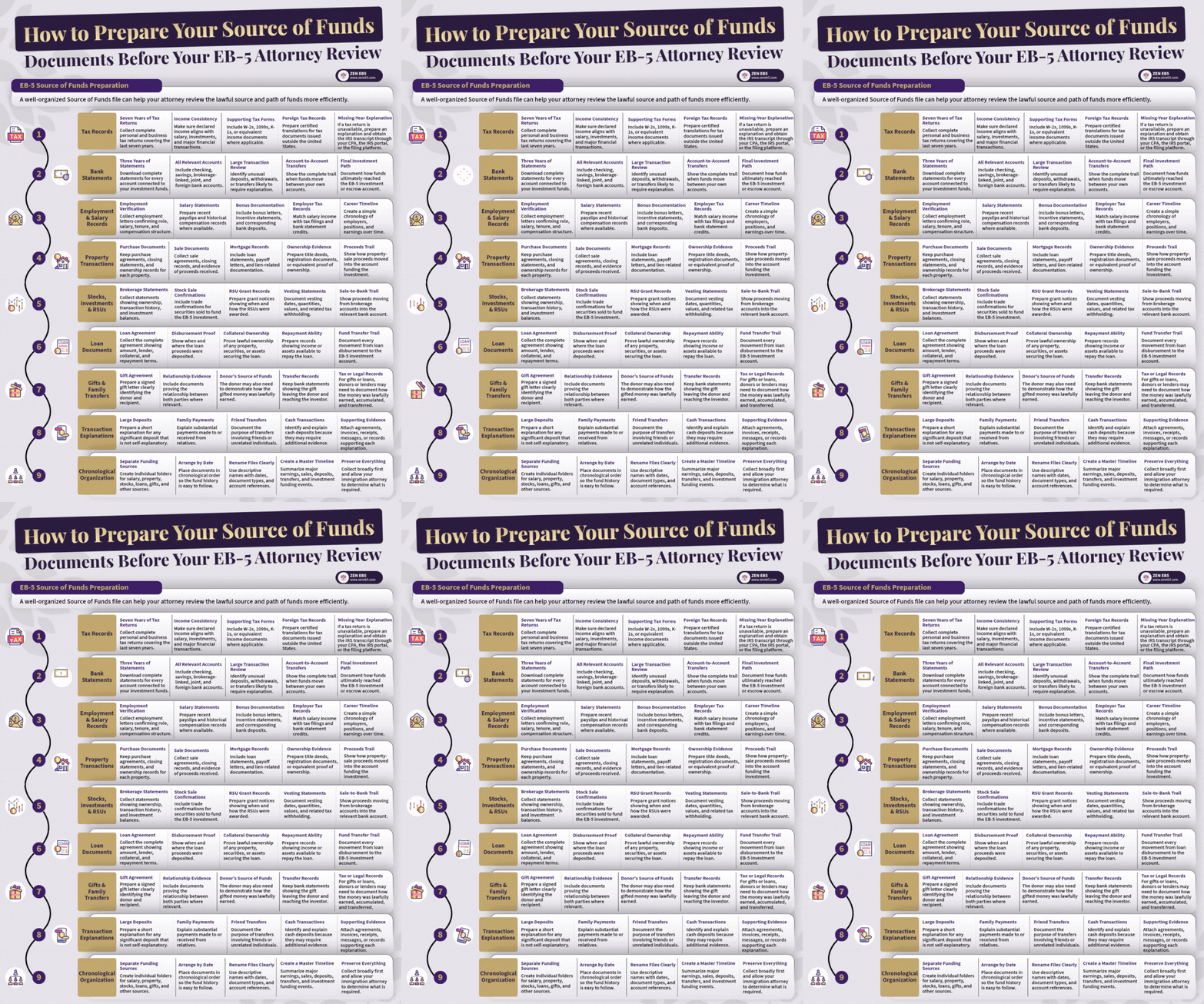
To make your attorney review seamless, organize your paperwork into these nine distinct categories. While not all may apply to your situation, you will likely need to address at least five or six.
Tax Records
Collect seven years of personal and business returns, including all supporting schedules, W-2s, 1099s, and K-1s (or foreign equivalents with certified translations). If a specific tax year is missing, pull your official IRS transcript and draft a quick explanation. Your declared income must align logically with the wealth you are investing.
Bank Statements
Provide three years of complete, page-by-page monthly statements for every single account connected to your investment checking, savings, brokerage, and foreign accounts. Any large or atypical deposits will require a written explanation. The final path showing funds moving from your account into the EB-5 escrow is the most critical page in the file.
Employment and Pay History
Secure employment verification letters showing your role, base salary, and tenure. Keep your recent pay stubs and annual bonus documentation handy. If you’ve climbed the ladder across multiple tech companies, a simple career timeline mapping your roles, companies, and dates provides excellent context for your attorney.
Real Estate Transactions
If any part of your capital comes from a property sale (US or foreign), you need the complete paper trail: the original purchase agreement, the final sale agreement, closing disclosures, title deeds, mortgage payoff records, and bank receipts showing the net proceeds hitting your account.
Stocks, Investments, and RSUs
Since RSUs are a massive component of tech compensation in the US, this section requires precision. You will need your brokerage statements showing ownership history, trade confirmations for securities sold, grant notices, and vesting statements showing tax withholdings along with the final transfer trail to your checking account.
Loan Documents
If you are financing your EB-5 capital through a secured or unsecured loan, you must document the full loan agreement, proof of disbursement, collateral ownership details, and your personal repayment capacity. Remember, USCIS requires the underlying collateral or source of the loan to be fully documented as well.
Gifts and Inter-Family Transfers
Gifts are fully permitted under EB-5 rules but require extra transparency. You will need a signed gift letter detailing the relationship, relationship evidence, and wire receipts. Crucially, your donor must also provide their source of funds documentation to prove how they originally generated that money.
Written Transaction Narratives
If a deposit, withdrawal, or transfer isn’t completely self-explanatory on a line item, don’t leave it to an adjudicator’s imagination. Write a short, clear narrative explaining the transaction and back it up with contracts, invoices, or receipts.
Clean, Chronological Organization
This is where you save weeks of back-and-forth. Create dedicated folders for each funding asset. Name your files descriptively (e.g., 2025_W2_Priya.pdf), arrange records chronologically, and create a master summary timeline. If it’s easy for your attorney to navigate, it will be easy for USCIS to process.
What to Look for in an EB-5 Project
While you clean up your financial history, you need to ensure your capital is going into a project designed to mitigate immigration and financial risk. For US-based professionals, four criteria matter most:
- Approved I-956F Status: Never invest in a project without an approved I-956F from USCIS. This means the government has already reviewed and signed off on the business plan and job creation model, eliminating major petition risk.
- A Significant Job Cushion: The EB-5 program requires your capital to create at least 10 full-time US jobs. A project that projects a massive job cushion creating significantly more jobs than the bare minimum safeguards your permanent Green Card if economic conditions shift.
- Defined Investment Terms: A clear, shorter investment timeline (like a 3-year term with a straightforward exit structure) gives you predictability on capital preservation and return.
- HUA Designation: Investing in a High Unemployment Area qualifies you for the lower $800,000 investment threshold and places your petition in a prioritized processing category.
Zenn@Legacy: Built for Investors Who Can’t Afford Uncertainty
If you are looking for a project engineered to meet these exact compliance metrics, Zenn@Legacy by ZEN EB5 is currently open for investment. It is a 140-unit Class A multifamily townhome development in Peoria, Arizona, inside the high-growth Phoenix metro corridor.
Here is how it de-risks the process for US visa holders:
- USCIS Pre-Approved: The project holds an approved I-956F, meaning its economic structure has already cleared federal review.
- Targeted Threshold: It features an official High Unemployment Area (HUA) designation, making the $800,000 minimum threshold fully applicable.
- Incredible Job Cushion: The project carries a 107% job cushion more than double the USCIS requirement giving your I-526E petition an exceptional safety margin.
- Clear Timeline: The investment is structured on a clean, competitive 3-year term.
Situated near a major Southwest logistics and employment hub with neighbors like Amazon, FedEx, and Costco the project’s job creation data is backed by real, ongoing economic demand. For an H-1B professional managing a demanding career while trying to escape the Green Card backlog, Zenn@Legacy removes the guesswork.
Your Next Steps
At the end of the day, your Source of Funds file isn’t just a administrative hurdle it is the legal foundation of your entire immigration future. By gathering your documents early, organizing them cleanly, and presenting a logical financial story, you save thousands in legal hours and clear the fastest path to your I-526E submission.
You don’t need to decide what ultimately stays in the final filing; that is your attorney’s job. Your job is to preserve the evidence, organize it well, and start before you’re up against a tight deadline.
If you want to map out how the EB-5 timeline fits your current US visa status, speak directly with the experts. Schedule a complimentary, zero-obligation consultation with the ZEN EB5 team at zeneb5.com/schedule/ and get complete clarity.