
Between 2013 and 2019, over $1 billion in EB-5 investor capital was lost, misappropriated, or frozen in failed U.S. project. Investors from India, China, South Korea, and across the world had done their due diligence — or thought they had. They read the pitch decks. They attended the webinars. They wired the money. Then the developer went silent, the construction stopped, and the green card clock kept ticking. This is not ancient history. It is the reason that for many immigrant investors today, the single biggest question about EB-5 is not “Which project?” It is: “Which firm can I actually trust?”
What a Broken EB-5 Experience Actually Costs
Imagine you are a senior software engineer on an H-1B visa. You have been in the United States for nine years. Your daughter was born here. Your professional network is here. Your entire career trajectory depends on staying.
You’ve been on an employer-sponsored green card path, but your priority date is stuck years out due to India-born EB-2 retrogression. You’ve watched the visa bulletin every month for four years. A colleague mentioned EB-5. You did your research, found a project, invested $800,000, and waited.
Eighteen months later, the regional center sends a vague email. The project has “experienced delays.” Construction has paused. Your I-526E petition is in limbo. The firm that took your capital now takes two weeks to return a call.
This is not a hypothetical. Thousands of immigrant investors have lived exactly this scenario. And the damage is not just financial. It is psychological, familial, and deeply personal. When an EB-5 project fails — or simply underperforms — the investor does not just lose capital. They lose time on their immigration clock. They lose confidence in a path they thought was secure. In some cases, they lose status entirely.
The EB-5 program itself is sound. USCIS approved it. Congress preserved it in the EB-5 Reform and Integrity Act of 2022, which actually strengthened investor protections. The problem was never the program. The problem was — and often still is — execution by the firms that run it.
Why the Standard EB-5 Firm Falls Short
Most EB-5 firms operate as intermediaries. They find a developer, structure a capital raise, market it to investors, collect their fees, and hand the investor off to a series of third-party vendors — attorneys, regional centers, project managers — none of whom feel fully accountable to the person who wrote the check.
The result is fragmented communication, slow responses, and a disturbing lack of transparency once the subscription agreement is signed. Investors are treated like capital sources, not partners.
The EB-5 Reform and Integrity Act of 2022 introduced meaningful safeguards — including mandatory securities disclosures, enhanced USCIS oversight of regional centers, and new investor protections against redeployment abuse. These changes helped. But no law can fix a firm whose fundamental model is built around closing the sale rather than executing the project.
USCIS processing timelines have also grown longer and more complex. I-526E petition adjudication currently takes many months. I-829 petitions — filed after the investment period to remove the conditions on a green card — carry their own processing times on top of that. An investor locked into a poorly managed project has very few options once the clock starts running. Choosing the wrong EB-5 partner is not a correctable mistake. It is an expensive one you live with for years.
How a Different Kind of EB-5 Firm Solves This
A trustworthy EB-5 investment firm does not just sell access to a project. It engineers the conditions under which that project succeeds — and then it shows you the evidence.
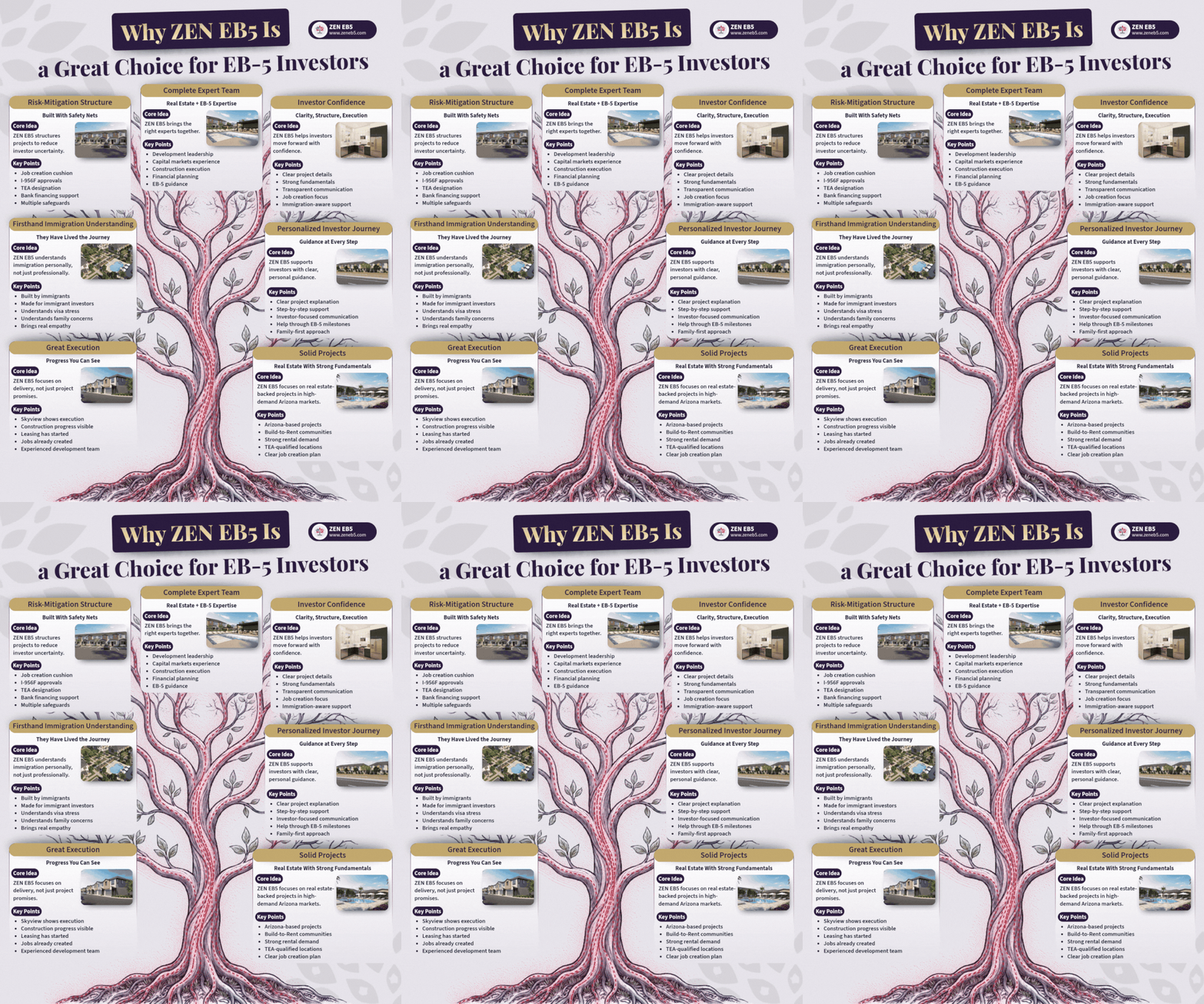
That means starting with a risk-mitigation structure, not finishing with one. It means job creation cushions built into the project from the beginning, not added as a footnote. It means I-956F approvals from USCIS confirmed before investors are asked to commit capital. It means TEA designation — a High Unemployment Area classification — secured so that the investment threshold qualifies at $800,000 rather than $1,050,000. It means bank financing support layered in so that investor capital is not the only thing standing between the project and completion.
Beyond structure, it means keeping the right people in the room. Real estate development, capital markets, construction management, financial planning, and EB-5 immigration expertise cannot be outsourced to five separate vendors with no shared accountability. They need to function as one integrated team — one that the investor can actually reach, and one that actually communicates.
That is not the standard in this industry. But it is the standard that matters most to an investor who has $800,000 and years of their life on the line.
What to Look for in an EB-5 Project
When you evaluate a specific EB-5 project, four things should be non-negotiable.
USCIS-approved I-956F petition. This is the project-level approval that confirms USCIS has reviewed the project’s job creation methodology, business plan, and economic analysis. Without it, you are investing in a project that has not cleared federal scrutiny. With it, you have independent confirmation that the project qualifies under current law.
Job creation cushion above 100%. The EB-5 program requires each $800,000 investment to support at least 10 full-time U.S. jobs. A project that barely meets that threshold leaves no margin for error. A project with a 107% job cushion means that even if job creation comes in below projections, the legal requirement is still met — and your petition is protected.
TEA or HUA designation. A Targeted Employment Area (TEA) or High Unemployment Area (HUA) designation is what allows the $800,000 investment threshold instead of $1,050,000. More importantly, it signals that the project is located in an area where job creation genuinely matters to USCIS — which tends to correlate with stronger federal scrutiny and cleaner approvals.
Visible execution, not just projections. Construction progress you can track. Leasing activity that has already started. Jobs that are already being created — not just modeled in a spreadsheet. The difference between a pitch and a proven project is what you can see with your own eyes.
Zenn@Legacy: Built for Investors Who Can’t Afford Uncertainty
Zenn@Legacy is a 140-unit Class A multifamily townhome development in Peoria, Arizona — in the Phoenix metro area — sponsored by EB-5 Coast to Coast Regional Center.
Every criterion above is met. The I-956F petition has been approved by USCIS. The project qualifies as a High Unemployment Area investment at the $800,000 threshold. The job creation cushion sits at 107%, providing a meaningful margin above the legal minimum. The investment term is structured at three years — a defined, finite timeline that gives investors clarity on when capital is expected to return.
The project is located near more than 100,000 jobs, including major employers such as Amazon, FedEx, Pepsi, and Costco. Phoenix metro’s multifamily rental market has remained one of the most active in the country, with strong underlying demand supporting the project’s fundamentals.
Skyview construction tracking provides visible, real-time progress. Leasing is active. The development is not a promise on paper — it is an asset in motion.
For an investor who has already waited years on the EB-2 or H-1B path — and who cannot absorb another setback — this is the kind of project structure that makes the decision defensible.
What This Means for You
If you are a visa holder evaluating EB-5 for the first time, or reconsidering it after being burned by vague pitches and slow communication, the answer is not to avoid the program. The answer is to choose the firm that built the program the way it should have been built from the start. The project matters. The structure matters. The team matters. And the firm standing behind all three matters most of all. You are not just making a financial investment — you are making an immigration decision with permanent consequences. That deserves a partner who takes it as seriously as you do.
If you want to understand whether the EB-5 program fits your situation, schedule a free consultation with the ZEN EB5 team at zeneb5.com/schedule/ — no obligation, just clarity.