
The EB-5 minimum investment amount was $500,000 for over a decade. Then, in March 2022, USCIS raised it to $800,000 almost overnight. Investors who had been waiting for the “right time” suddenly faced a $300,000 higher bar — with no warning and no grace period. Many had to restructure their plans entirely. Some simply missed the window.
This was not a one-time event. It is how immigration policy works. In fact, history is about to repeat itself: a scheduled increase in the minimum investment amount is officially coming in January 2027. Immigration policies change, often without much notice, and the people who wait pay more — in money, in time, and sometimes in options they no longer have.
If you are an Indian national on an H-1B, L-1, or F-1 visa considering the EB-5 program, this upcoming deadline is exactly why timing matters — and why filing today is not just financially smart. It is a protective move to beat the January 2027 price hike before the window closes.
The Real Cost of Waiting
Consider a typical scenario. You are an Indian professional working in the U.S. on an H-1B visa. You have been in the country for seven or eight years. Your priority date under the EB-2 or EB-3 employment-based categories is stuck — the India backlog means your wait for a green card could stretch another 10, 15, or even 20 years.
You have heard about EB-5. You know it is an investor visa that creates a faster path. But the investment feels big, the process feels uncertain, and you keep telling yourself you will look into it more seriously next year.
Here is what next year actually costs you: a higher investment threshold, a later priority date, fewer project options, and the loss of every protection that comes with filing under today’s rules. The EB-5 program rewards early action. It penalizes delay in ways that are concrete, measurable, and often irreversible.
Why Employment-Based Visa Categories Are Not Enough
For Indian nationals, the EB-2 and EB-3 employment-based visa categories are severely backlogged. The U.S. Department of State’s visa bulletin shows that Indian applicants in these categories are waiting for priority dates from 2012 and 2013. That is not a typo. In some subcategories, the effective wait time for a new applicant today exceeds 50 years.
H-1B renewals depend entirely on your employer’s sponsorship and USCIS’s discretion. A layoff, a company restructuring, or a policy shift can derail years of status maintenance in weeks. The 60-day grace period for H-1B holders who lose their jobs is a thin buffer against a very real cliff.
The EB-5 Immigrant Investor Program was created precisely for this situation. It gives individuals — rather than employers — control over their permanent residency path. Filing an I-526E petition through a USCIS-designated regional center starts a clock that no employer layoff can stop, no visa bulletin can push back, and no future policy change can unwind.
But that protection only exists once you file. Until then, you have nothing locked in.
How EB-5 Filing Now Protects Indian Investors
Filing your EB-5 petition now creates a wall of protection around your immigration future. Here is what that means in specific terms.
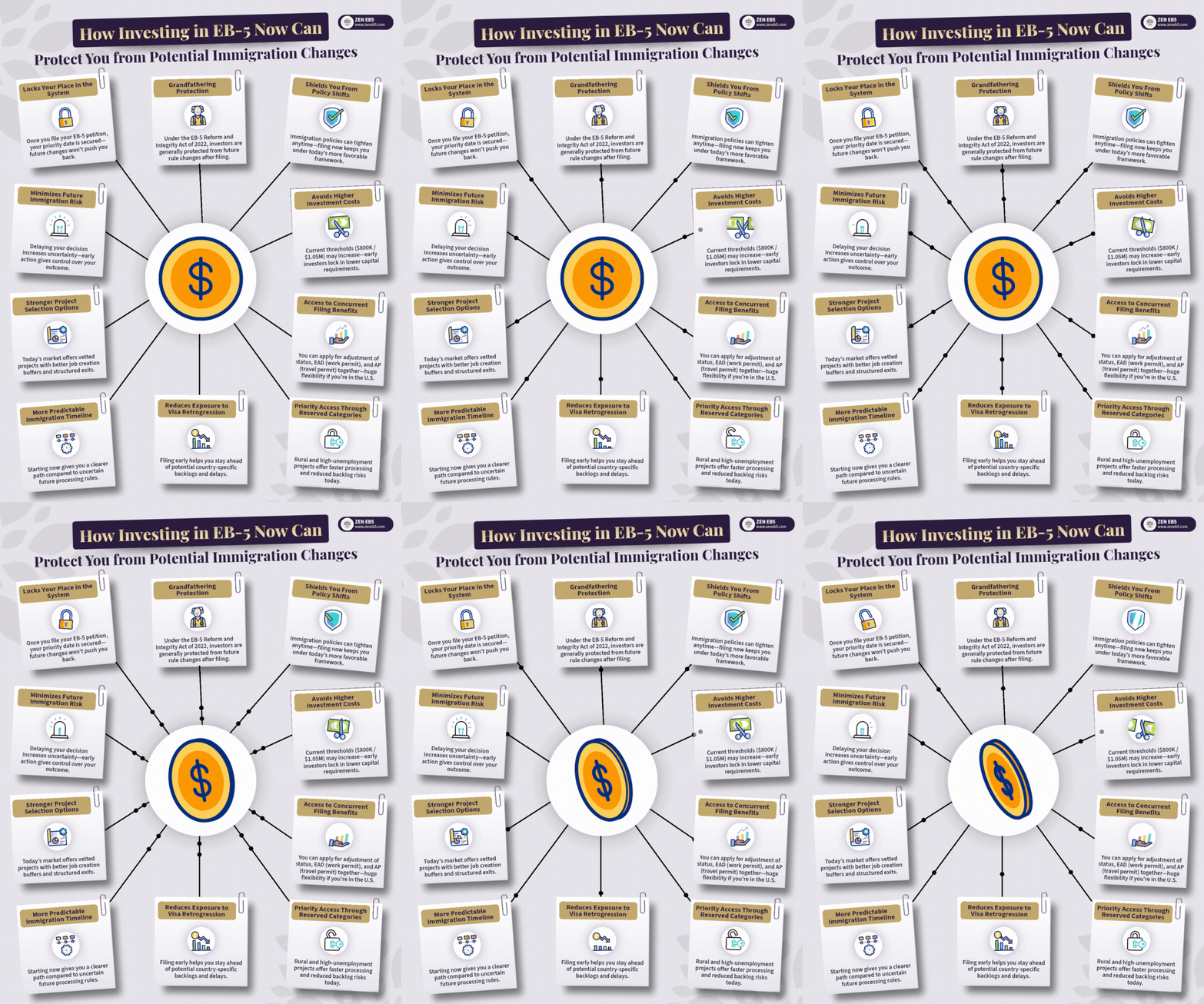
Your priority date is secured the moment your I-526E is filed. Under the EB-5 program, Indian nationals are not subject to the same catastrophic backlogs that affect EB-2 and EB-3 applicants. That advantage is available right now — but only if you file.
The EB-5 Reform and Integrity Act of 2022 includes grandfathering provisions that protect investors from future rule changes after their petition is filed. If Congress raises the investment minimum again — from $800,000 to $1,050,000 or higher — you are protected. The threshold you filed under is the threshold you keep. Investors who wait lose that protection entirely.
If you are already in the U.S. on a valid visa and an EB-5 visa number is immediately available, you may be eligible for concurrent filing — submitting your I-526E petition alongside an I-485 adjustment of status application, an Employment Authorization Document (EAD), and an Advance Parole travel document at the same time. This means you could be authorized to work independently of your H-1B sponsor and travel internationally without jeopardizing your green card application, often within months of filing. That level of flexibility is not available through any employer-sponsored category.
Filing early also reduces your exposure to visa retrogression. If demand in the EB-5 category increases — and it has historically — priority dates can move backward. Investors who file now are ahead of that risk. Those who wait may find themselves behind a growing line.
Finally, the current market offers better project quality. Post-reform, USCIS scrutiny has pushed weaker EB-5 project out of the market. The project available today tend to have stronger job creation buffers, more transparent structures, and cleaner exit strategies. That is not guaranteed to continue as more capital flows back into the program.
What to Look for in an EB-5 Project Before You File
Not all EB-5 project carry the same risk profile. Before you commit capital, four factors matter more than any marketing material.
Job creation cushion: Every EB-5 investment must directly or indirectly satisfy the job creation requirement — a minimum of 10 full-time U.S. jobs per investor. A responsible project targets significantly more, because if the actual job count falls short, the investor’s green card is at risk. Look for a buffer of at least 50% above the minimum. Anything under that is tight.
HUA designation: project located in a High Unemployment Area (HUA) require only $800,000 in EB-5 capital at risk rather than $1,050,000. This is a USCIS-designated classification, not a developer’s claim. Verify it independently. A genuine HUA designation is one of the most investor-friendly features a project can offer.
USCIS approval status: Has the regional center sponsoring the project received I-956F approval from USCIS for this specific project? That approval means USCIS has reviewed the project’s structure, job creation methodology, and business plan. Without it, you are investing in something that has not yet passed federal review.
Investment term and exit clarity: A 3-year investment term with a clearly defined repayment structure is a sign of a project built with the investor’s timeline in mind. Open-ended terms with vague exit language are a red flag. Your EB-5 capital is “at risk” by legal requirement — but a well-structured project mitigates that risk through timeline discipline.
Zenn@Legacy: Built for Investors Who Can’t Afford Uncertainty
ZEN EB5’s currently active project, Zenn@Legacy, is a 140-unit Class A multifamily townhome development in Peoria, Arizona — part of the Greater Phoenix metro area, one of the strongest real estate markets in the country.
The project is sponsored by EB-5 Coast to Coast Regional Center and has received USCIS I-956F approval — meaning the federal government has reviewed and cleared the project structure before a single investor dollar went in.
Zenn@Legacy qualifies as a High Unemployment Area investment, so the minimum investment is $800,000 rather than $1,050,000. That $250,000 difference is real money. And investors who file now lock in that threshold even if USCIS raises it in the future.
The project carries a 107% job creation cushion — meaning it is projected to create more than double the minimum number of U.S. jobs required. For Indian investors whose green card depends on those jobs being verified, that cushion is not marketing language. It is a structural buffer against the most common source of EB-5 petition failure.
The investment term is 3 years, with a clear exit structure tied to the project’s development and stabilization. The project sits minutes from over 100,000 jobs — including Amazon, FedEx, Pepsi, and Costco operations — which directly supports the employment projections that underpin every investor’s I-526E petition.
For investors who cannot afford to wait on their green card, and cannot afford to get the investment wrong, Zenn@Legacy was designed with that exact profile in mind.
What This Means for You
If you are an Indian national in the U.S. on an employment-based visa, the EB-5 program offers something no employer-sponsored category can: a path to permanent residency that you control. But that path has a cost — and that cost goes up over time. The investment threshold can rise. The rules can change. The backlog dynamics can shift.
Filing your EB-5 petition now does not just get you into the process. It locks in your priority date, protects you from future threshold increases, qualifies you for concurrent filing benefits, and shields you under today’s grandfathering rules. Every month you wait is a month of protection you do not have.
The question is not whether EB-5 is the right path. The question is whether you act while the conditions are in your favor — or wait until they are not.
If you want to understand whether the EB-5 program fits your situation, schedule a free consultation with the ZEN EB5 team at zeneb5.com/schedule/ — no obligation, just clarity.