
You’ve spent years building your career in the U.S. on an H-1B visa. You’ve saved more than most people see in a lifetime. And now you’re looking at an EB-5 investment — $800,000 into a real estate project you’ve never visited, sponsored by a developer you’ve never met. The question that keeps surfacing: Is anyone else watching this project besides me?
The answer, in well-structured deals, is yes. And that answer has a name: lender involvement. When a bank has committed capital to the same project you’re investing in, your interests don’t just align — they become structurally enforced.
Why Most EB-5 Investors Miss This Completely
When investors evaluate EB-5 project, they tend to focus on the right things: job creation numbers, TEA designation, the developer’s track record, and the regional center’s approval status. These are all critical. But there’s a layer of due diligence most investors never ask about — and it’s already baked into better-structured deals.
That layer is the institutional lender.
Consider a realistic scenario. Two EB-5 investors — both H-1B engineers, both evaluating multifamily projects in growing Sun Belt markets — are comparing deals side by side. Project A has strong fundamentals on paper. Project B has the same fundamentals, plus a senior construction loan from an experienced regional bank that has reviewed the project’s financials, underwritten its assumptions, and committed its own capital.
Which deal has an extra set of expert eyes watching the budget, the construction timeline, and the exit strategy?
The answer is obvious once you know to ask the question. Most investors never do.
What Lenders Actually Do — and Why It Matters for EB-5 Capital
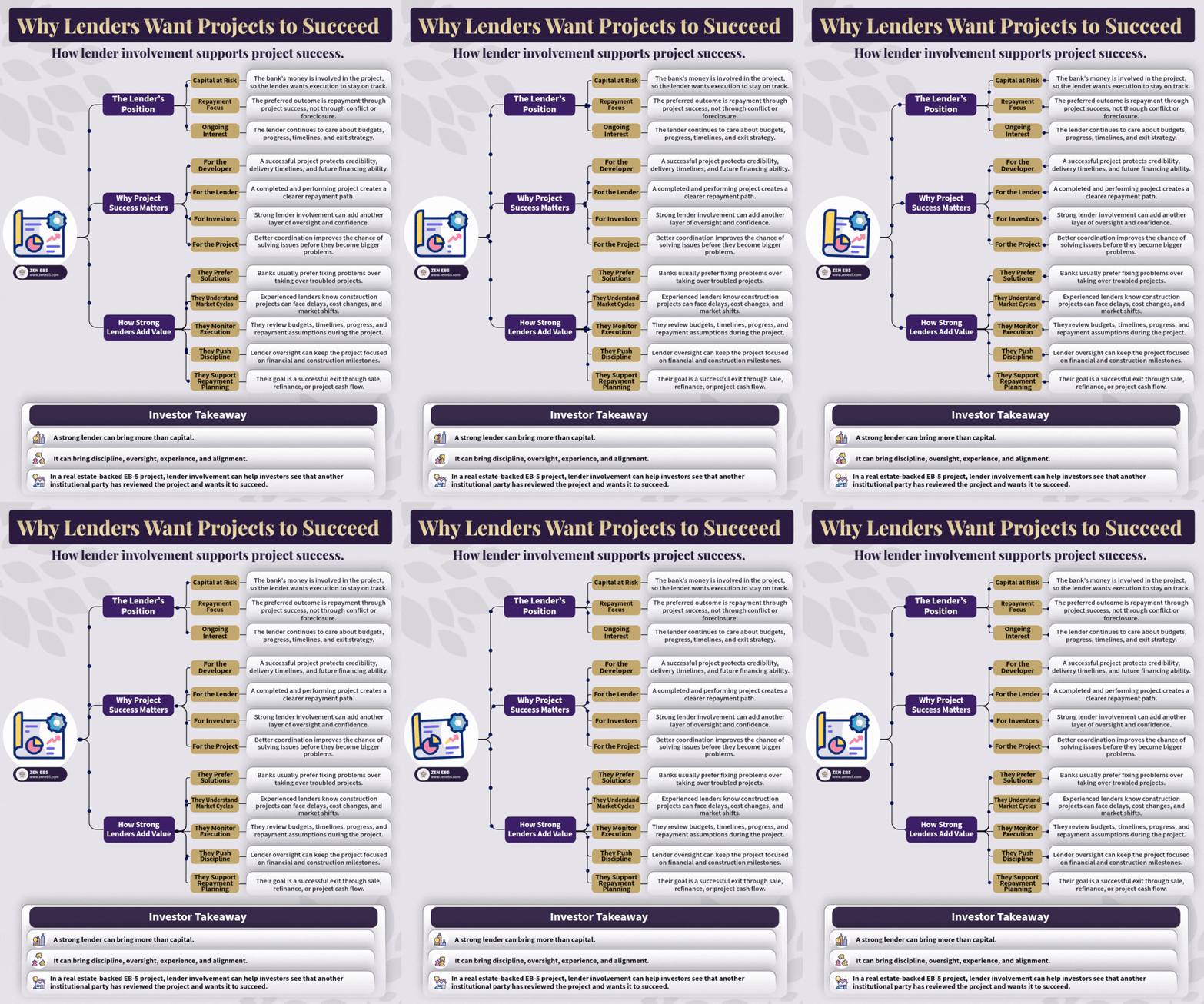
Lender involvement is often framed as a financing mechanism. But in real estate-backed EB-5 project, a strong lender does something that matters just as much as the capital it provides: it monitors.
Here’s what institutional lenders typically do once a project breaks ground:
They review budgets and construction draw requests. Before releasing funds at each phase, lenders verify that work is actually complete and costs are on track. This isn’t bureaucratic paperwork — it’s a check on developer discipline.
They track timelines and repayment assumptions. Lenders model what a successful exit looks like — whether that’s a sale, refinance, or cash flow — and they check progress against that model throughout the project.
They prefer solutions over seizure. Banks don’t want to take over troubled construction projects. That process is slow, expensive, and damaging. Their strong preference is to work through problems early, before they escalate. For an EB-5 investor, that preference translates to institutional pressure toward project completion.
They understand market cycles. Experienced construction lenders have seen delays, cost overruns, and market shifts before. They know how to read early warning signs. That experience is available to the project at no extra cost to the investor.
None of this eliminates risk. The EB-5 program is inherently a capital-at-risk investment, and USCIS is clear about that. No lender can guarantee a project will succeed. But lender alignment — when a bank has its own money in the deal and its own reputation on the line — creates a structural incentive for oversight that benefits everyone: the developer, the lender, and especially the EB-5 investor.
Why EB-5 Investors Can’t Rely on Optimism Alone
The EB-5 Reform and Integrity Act of 2022 (part of the Consolidated Appropriations Act) introduced significantly stronger protections for investors, including new requirements around regional center accountability, project transparency, and EB-5 Integrity Fund contributions. These were overdue reforms — and they matter.
But regulatory reform doesn’t replace project-level oversight. USCIS approves a project’s I-956F petition based on the economic and structural merits at the time of filing. Once a project is approved and funded, the day-to-day execution is in the hands of the developer and their capital partners.
That’s where a committed lender becomes particularly important.
For visa-dependent investors — people whose immigration status is tied to a project completing, creating jobs, and sustaining the investment through the I-829 petition stage — there’s no margin for wishful thinking. The job creation requirement must be met. The capital must remain at risk for the right duration. The project must perform.
An institutional lender with capital in the deal has every reason to help ensure those outcomes happen.
What to Look for When Evaluating an EB-5 Project
Not all lender involvement is created equal. Here’s what to actually look for when reviewing a project’s capital structure and oversight:
- Is there a senior construction lender? A project with no institutional lending is entirely developer-controlled. There’s no external review of draw requests, no independent eye on the budget. That’s a meaningful difference.
- Is the lender experienced in construction finance? A lender who has never financed multifamily ground-up construction won’t catch the same warning signs as one who has underwritten dozens of similar projects. Ask about the lender’s track record.
- Does the project have a clear exit strategy the lender has underwritten? Lenders model repayment paths. If the developer can clearly articulate the exit — sale, refinance, or stabilized cash flow — and that exit has been reviewed by an institutional lender, it’s a more credible story than a developer’s projection alone.
- Is the project’s capital stack transparent? You should be able to see where the EB-5 capital sits relative to senior debt, mezzanine financing, and developer equity. Transparency here is a basic standard for any serious EB-5 project.
For investors filing an I-526E petition and planning to adjust status in the U.S., these questions matter from day one. You’re not a passive participant in this investment — you’re entitled to understand how it’s structured.
Zenn@Legacy: Built for Investors Who Can’t Afford Uncertainty
Zenn@Legacy is ZEN EB5’s currently active project — a 140-unit Class A multifamily townhome development in Peoria, Arizona, in the Phoenix metro area. It’s designed from the ground up with the kind of structural clarity that serious EB-5 investors should expect.
A few specifics worth knowing:
The project is USCIS-approved with a filed I-956F, sponsored through EB-5 Coast to Coast Regional Center. It qualifies as a High Unemployment Area (HUA) investment, which means the minimum investment is $800,000 — not $1,050,000 — and the job creation per investor threshold is calculated under more favorable terms.
The project carries a 107% job cushion above the minimum required job count. That’s not a rounding error — it’s a structural buffer designed specifically to protect investors at the I-829 petition stage, when USCIS verifies that actual jobs were created.
The investment term is 3 years — shorter than many EB-5 deals, which often run 5 to 7 years.
And the location matters. Peoria, Arizona sits inside a Phoenix metro corridor with more than 100,000 nearby jobs, including anchor employers like Amazon, FedEx, Pepsi, and Costco. Demand for Class A housing in this market isn’t speculative — it’s documented.
For investors evaluating lender alignment and institutional oversight, Zenn@Legacy’s capital structure reflects those principles. The project is built to be accountable, not just approvable.
What This Means for You
If you’re evaluating EB-5 investment projects, lender involvement should be on your checklist — not as a bonus feature, but as a meaningful signal about project quality and oversight. A bank that has committed its own capital to a project has done a level of underwriting that no brochure can replicate.
That institutional alignment doesn’t make a project risk-free. But it does mean you’re not the only party watching the project’s execution. And for an immigrant investor whose green card timeline depends on a project completing successfully, that’s not a small thing.
The best EB-5 project don’t just have good numbers. They have institutional support, transparent capital structures, and built-in accountability mechanisms. That’s the standard worth holding every project to.
If you want to understand whether the EB-5 program fits your situation, schedule a free consultation with the ZEN EB5 team at zeneb5.com/schedule/ — no obligation, just clarity.