
The Window Is Closing — and Most Visa Holders Don’t Know It
You have been in the United States for years. You have built a career, paid taxes, maybe bought a home. Your H-1B status depends entirely on an employer who could restructure next quarter. Your F-1 OPT clock is counting down. Your L-1 extension is not guaranteed. Meanwhile, the one path that could give you permanent residency independent of any employer — the EB-5 Immigrant Investor Program — has hard legislative deadlines that are moving faster than most people realize.
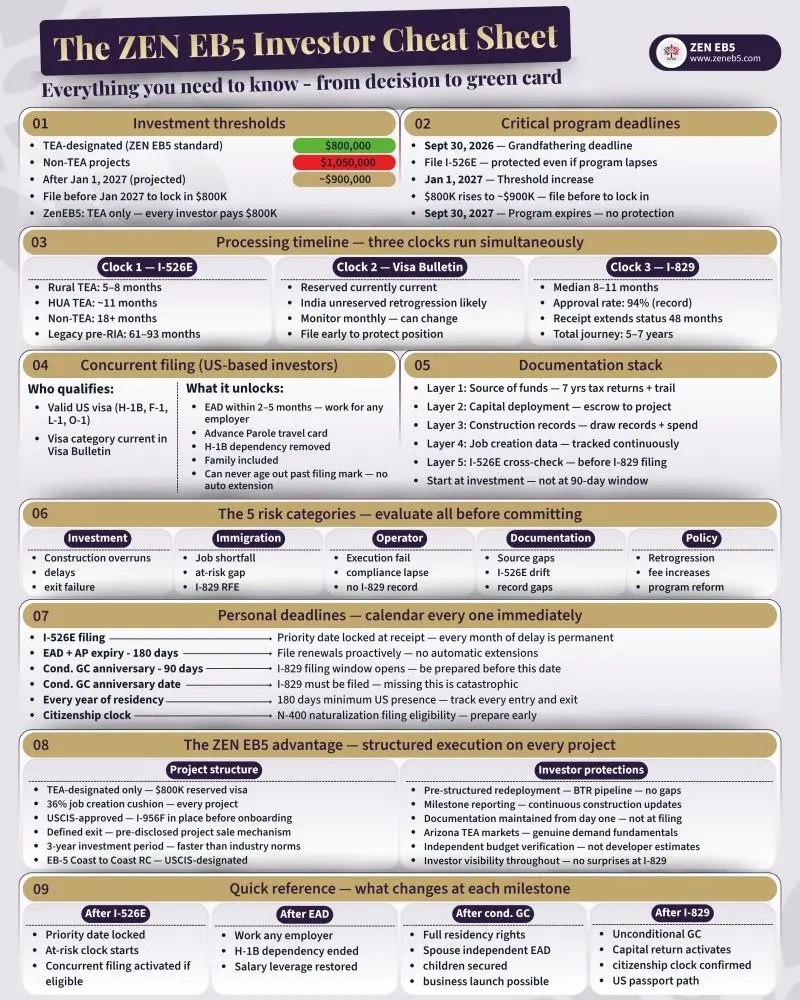
September 30, 2026 is the grandfathering deadline. File your I-526E petition before that date and you are protected, even if the program lapses. Miss it, and the $800,000 investment threshold rises to approximately $900,000 on January 1, 2027. By September 30, 2027, if Congress does not reauthorize the program, it expires entirely.
This EB-5 investor cheat sheet covers everything: thresholds, timelines, concurrent filing, documentation, and risk evaluation — the same framework the ZEN EB5 team uses with every investor.
The Problem with Waiting
Consider a realistic scenario: a software engineer on H-1B status, 12 years in the U.S., spouse and two children also here on derivative visas. The family has been waiting for a green card through the employer-sponsored EB-2 path. India-born. The priority date on the visa bulletin: 2013.
At current movement rates, that family is looking at decades more of waiting — all while their immigration status remains tied to a single employer. One layoff, one acquisition, one policy change, and they are back to square one.
The EB-5 path is different. It is not employer-dependent. The priority date is available now for most visa categories. And for U.S.-based investors, concurrent filing means you can file for adjustment of status at the same time as your I-526E petition — activating work authorization within two to five months.
That is not a small detail. That is job freedom, travel flexibility, and the removal of H-1B dependency — before the green card even arrives.
Why the Standard Green Card Path Does Not Work for Most Immigrant Professionals
The employment-based green card system was not built for the volume of people now using it. EB-2 and EB-3 backlogs for India-born applicants run 50 to 80+ years at current processing rates. China-born applicants face waits measured in decades as well. The system is not broken — it is simply overwhelmed.
Meanwhile, the EB-5 program — created precisely for this — is underutilized because most immigrant professionals assume it requires $1 million, or that it is only for wealthy foreign nationals, or that it is too complex to understand.
None of those assumptions are accurate in 2026.
Key fact: TEA-designated (Targeted Employment Area) projects qualify at the $800,000 threshold. ZEN EB5 works exclusively with TEA projects, which means every investor pays $800,000 — not $1,050,000.
The EB-5 Reform and Integrity Act of 2022 restructured the program significantly. It created the reserved visa category, which gives rural TEA and High Unemployment Area (HUA) projects priority access to visa numbers. That is why the visa bulletin currently shows reserved categories as current — meaning there is no wait for most investors who qualify. Unreserved categories face retrogression risk, particularly for India-born applicants, which is why project selection matters.
How EB-5 Solves the Visa Dependency Problem
The EB-5 Immigrant Investor Program grants permanent residency in exchange for a qualifying capital investment in a USCIS-approved project that creates a minimum of 10 full-time U.S. jobs. The investment is at risk — it is not a fee, and it is not a donation. But it is also not speculative: well-structured projects with real job creation records and independent budget verification have tracked I-829 approval rates above 94%.
Here is how the process flows for a U.S.-based investor:
- File the I-526E petition (the initial immigration petition) with USCIS.
- If your visa category is current in the Visa Bulletin and you hold a valid U.S. visa, file for concurrent adjustment of status — this activates your EAD (Employment Authorization Document) and Advance Parole within two to five months.
- Receive the conditional green card (two-year conditional permanent residency) once the I-526E is approved.
- File the I-829 petition (removal of conditions) no earlier than 90 days before the two-year conditional GC anniversary.
- Receive unconditional green card. Capital return activates. Citizenship clock begins.
Three clocks run simultaneously from the day you file. Clock one: I-526E processing. For HUA-designated TEA projects, the current median is approximately 11 months. Clock two: the Visa Bulletin. Reserved categories are currently current, but this is monitored monthly — file early to protect your position. Clock three: I-829 processing, with a current median of 8 to 11 months and a 94% approval rate on record.
Total estimated journey from filing to unconditional green card: five to seven years. For a family that has already spent a decade waiting on employer-sponsored backlog, that is not a long time. It is a finish line.
What to Look for in an EB-5 Project Before You Commit
The project you choose is not a formality. It is the foundation of your immigration case. A weak project — one with construction delays, job shortfalls, or sloppy documentation — can result in an I-829 denial years after you thought the process was done. These are the four criteria that matter most.
- TEA or HUA Designation TEA designation qualifies the project for the $800,000 threshold and access to the reserved visa category under the IA-22 framework. HUA designation specifically covers areas with unemployment at 150% or more of the national average. Both give investors access to the reserved visa bulletin category, which is currently current. Non-TEA projects require $1,050,000 and face unreserved retrogression risk.
- Job Creation Cushion Each investor requires 10 direct or indirect job creation credits. The job cushion measures how much excess job creation the project is underwriting beyond the minimum required. A 107% job cushion means the project’s economic model projects more than double the required jobs — giving investors meaningful protection against shortfalls that could trigger I-829 issues.
- USCIS-Approved I-956F Before Onboarding This is not optional. The I-956F is USCIS’s approval of the project-specific EB-5 offering before investors commit. A regional center that asks you to invest before this approval is asking you to take on approval risk. Require it in writing, confirmed, before you transfer capital.
- Independent Budget Verification Developer budget estimates are not the same as independent verification. Third-party budget review protects investors from cost overruns that could delay job creation, extend the investment period, or compromise the I-829 filing. This is a basic investor protection that serious operators provide as standard — not as a premium feature.
Zenn@Legacy: Built for Investors Who Cannot Afford Uncertainty
ZEN EB5’s currently active project is Zenn@Legacy — a 140-unit Class A multifamily townhome development in Peoria, Arizona, in the Phoenix metro area. The project checks every box on the evaluation framework above, and then some.
- HUA-designated: qualifies for the $800,000 TEA threshold and access to the reserved visa category.
- USCIS-approved: I-956F in place before investor onboarding — no approval risk.
- 107% job creation cushion: the project’s economic model projects more than double the required jobs per investor position.
- 3-year investment period: faster than the industry norm, with a pre-disclosed exit mechanism via project sale.
- Sponsored by EB-5 Coast to Coast Regional Center: USCIS-designated, with a track record and compliance infrastructure already in place.
- Located near 100,000+ jobs: Amazon, FedEx, Pepsi, and Costco facilities in close proximity, supporting genuine employment demand.
- Independent budget verification: third-party verified construction budgets, not developer self-reporting.
- Investor visibility throughout: milestone reporting and documentation maintained from day one — not assembled at I-829 filing.
Arizona TEA markets reflect real housing demand — not speculative plays. Peoria sits inside one of the fastest-growing employment corridors in the Southwest, which is exactly the kind of underlying demand that supports job creation projections and reduces construction risk. Learn more about the project at zeneb5.com/zenn-legacy.
The 5-Layer Documentation Stack — Start Now, Not at Filing
Documentation is where green card cases are won or lost. The EB-5 documentation requirement is not a checklist you complete right before filing. It is a record that starts at investment and runs continuously through I-829 approval. These are the five layers:
- Layer 1 — Source of funds: seven years of tax returns, plus a complete paper trail showing the lawful origin of your capital.
- Layer 2 — Capital deployment: escrow records showing the path from your bank account to the project.
- Layer 3 — Construction records: draw records and spend documentation proving the project is actively being built.
- Layer 4 — Job creation data: continuously tracked employment records, updated throughout the investment period.
- Layer 5 — I-526E cross-check: a reconciliation of the original petition’s claims against actual project performance, completed before I-829 filing.
A critical note: start building Layer 1 at the point of investment, not at the 90-day window before I-829. USCIS reviewers can identify documentation assembled after the fact. The investors who sail through I-829 are the ones whose records were maintained in real time.
The Five Risk Categories — Evaluate All Before Committing
Every EB-5 investment carries risk. That is not a warning designed to discourage — it is the accurate statement that USCIS requires you to acknowledge. The discipline is in knowing where the risk lives and how the operator has addressed it.
Investment risk: Construction overruns, project delays, and exit failure. Mitigated by independent budget verification, defined exit mechanisms, and realistic construction timelines.
Immigration risk: Job shortfall, at-risk capital gap, and I-829 RFE (Request for Evidence). Mitigated by a 107%+ job cushion and documentation maintained from day one.
Operator risk: Execution failure, compliance lapse, and no I-829 record. Mitigated by working with a USCIS-designated regional center with a track record and compliance infrastructure.
Documentation risk: Source fund gaps, I-526E drift (where the petition’s claims diverge from reality), and record gaps. Mitigated by proactive documentation from the investor’s side and milestone reporting from the operator.
Policy risk: Visa retrogression, fee increases, and program reform. Mitigated by filing early, securing the priority date before deadlines, and selecting a project in the reserved visa category.
Calendar These Deadlines Immediately
The most common mistake in EB-5 is treating it as a future decision. Every month of delay between now and filing is a permanent loss of priority date positioning. These are the personal deadlines that require immediate attention:
- I-526E filing date: priority date locks at the date of receipt. Every month of delay is permanent.
- EAD and Advance Parole expiry (180 days): renewals must be filed proactively — there are no automatic extensions.
- Conditional GC anniversary — 90 days prior: this is when the I-829 filing window opens. Be prepared before this date.
- Conditional GC anniversary date: the I-829 must be filed. Missing this deadline is catastrophic — it can result in loss of status.
- Every year of residency: minimum 180 days of U.S. physical presence is required. Track every entry and exit.
- Citizenship clock: N-400 naturalization eligibility begins five years after receiving the conditional GC. Prepare early.
What This Means for You
If you are on an H-1B, F-1, or L-1 visa and you have been in the U.S. for more than three years, there is a reasonable chance that EB-5 is the fastest path to permanent residency available to you today. The employment-based backlog has no end in sight. The O-1 and EB-1 paths require extraordinary evidence most professionals cannot meet. The EB-5 path is based on a qualifying investment and a qualifying project — criteria that are objective and verifiable.
The September 30, 2026 grandfathering deadline is real. Filing before that date locks in the $800,000 threshold and protects your I-526E even if the program lapses. Filing after January 1, 2027 means paying approximately $900,000. Filing after September 30, 2027 — assuming no reauthorization — means no program to file under.
You are in control of this decision. The only variable you cannot manage is time.
If you want to understand whether the EB-5 program fits your situation, schedule a free consultation with the ZEN EB5 team at zeneb5.com/schedule/ — no obligation, just clarity.